Monthly Archives: July 2012

Vilcabamba and back to Cuenca

We’ve had a busy two weeks since our last posting, and were cut off from the internet (how horrible!) for a time.  In summary, we had a 4 day break from classes July 20-23, which we spent traveling to Vilcabamba, staying at the Izhcayluma Hostel, and then back to Cuenca for classes.  This weekend we took two local trips, to Cueva de Chobshi (an early habitation site) and to the Ingaprica ruins of Cañari & Inka origins.  On Sunday we encountered our first real rainy day since our arrival.   We’re now in our last week in Ecuador and its sunny and warm again.

We had learned about Vilcabamba from our travel guide books.  It has a reputation for the longevity of its inhabitants, and has become a mecca for both hippies and ex-pats with large homes in the fertile valley area.  It appealed to us because it’s at a lower elevation and thus warmer than Cuenca.  The hotel we stayed at, Izhcayluma, was rated highly by the books and other recommendations, and it met our expectations.

After narrowly avoiding (by less than a minute) being stuck in our Cuenca building’s elevator by a power failure (which reportedly lasted hours) as we left early Friday morning, we took a 3-passenger taxi-van South along the Pan American highway to the city of Loja, about a 4 hour drive through several mountains and valleys.  In Loja we quickly transferred to another taxi which took us directly to Izhcayluma.  For the two of us, the first leg was $24, and the second leg was $20, arriving around 3pm.

Izhcayluma is about 10 minutes outside of Vilcabamba, but we were delayed about 20 minutes by road construction where they we laying out a new stretch of concrete highway to complete a link to the Peru border.  Izhcayluma is owned by Germans and has lush gardens, a pool, a bar and wi-fi. We were given a nice room, at $45/night including breakfast, in a cottage with a private deck overlooking a hillside and a hammock.  The hotel has an open-sided dining pavilion with views of the Vilcabamba valley and serves a delicious menu with choices of Ecuadorian and German dishes.  It was warm enough that we left the door to our room’s deck open all night, but it seemed to have a constant breeze with strong gusts from time to time.
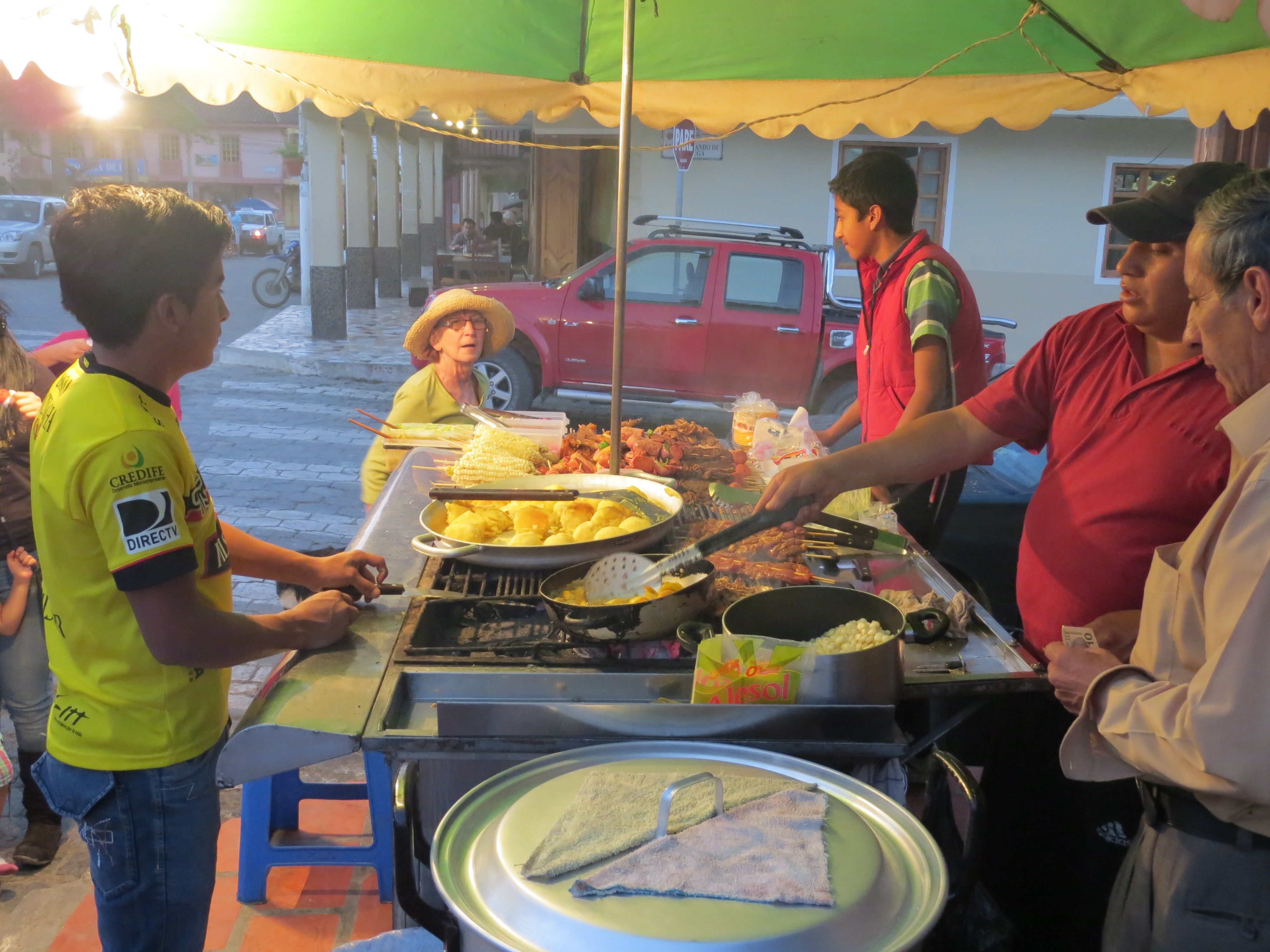
Street food in Vilcabamba

We walked down to the Vilcabamba village on Saturday, a pleasant stroll through neighborhoods of small houses and gardens of banana trees and other tropical treats.  One patio was covered with coffee beans drying in the sun.  The village itself is about 6 blocks by 8 blocks, seemingly consisting of vacant houses on the outer perimeter and most activity and businesses centered around the town square.  Several of the food establishments were apparently owned by ex-pat Americans, and there were several Americans (hippies and others) hanging around in a very relaxed atmosphere.  We had pizza & beers at one place run by a Mexican who had gone to high school in Boston.
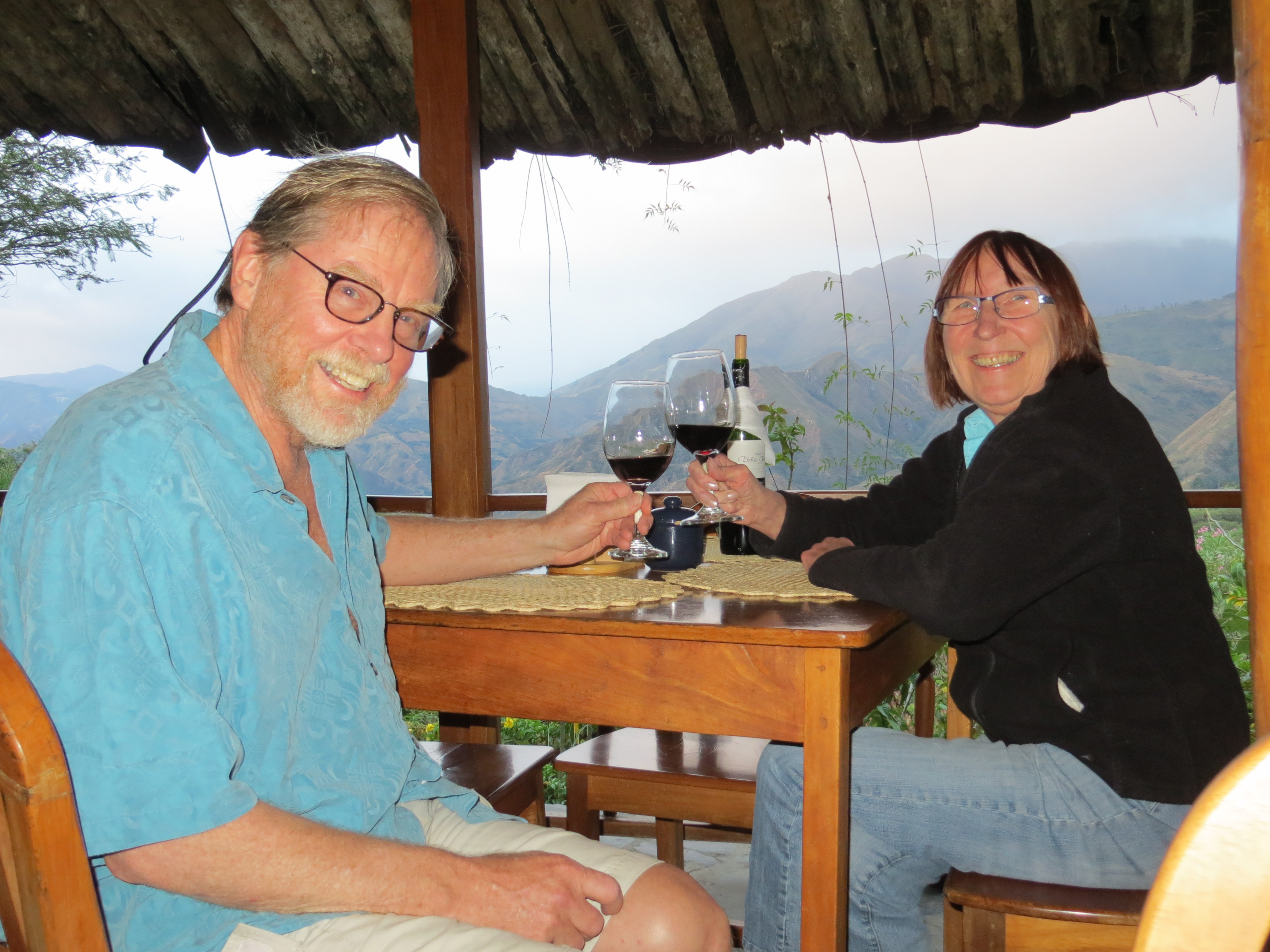
Dining at Izhcayluma

Sunday John took one of the recommended hiking routes around the perimeter of Vilcabamba valley, along a dirt road which became a narrow trail that followed an irrigation canal.  It had beautiful views of the valley and included dodging lounging cattle and grazing horses.  Jessie stayed at Izhcayluma with her computer, taking advantage of the wi-fi.  We had a great meals Sunday night of chicken strogonoff & roast chicken with pineapple (about $15 each with wine).

Mid-morning Monday we took a taxi to Loja (shared 3-ways for $15 total) which dropped us off at the bus terminal where we immediately boarded a bus ($15 for both of us) with reserved seats.  The bus was comfortable  but crowded, and Jessie shared her seat with a woman & young child who traveled about 2 hours before getting off in a village.  Time to Cuenca was about 4.5 hours.

Back to school on Tuesday morning followed by an energetic one-hour Salsa lesson Tuesday night, which about did us in.  We had a couple of lunches at El Tunel during the week, a local place which serves very tasty 3-course meals (fixed menu almuerzo) for $2.25 each with quick and efficient service.

On Friday the school held a special event, with the students and teachers presenting the various features and dress of the 4 regions of Ecuador: the Amazon basin, the Andes, the coastal areas and the Galapagos islands.  It was great fun for all, and Jessie’s team won 1st prise for their Amazon presentation.
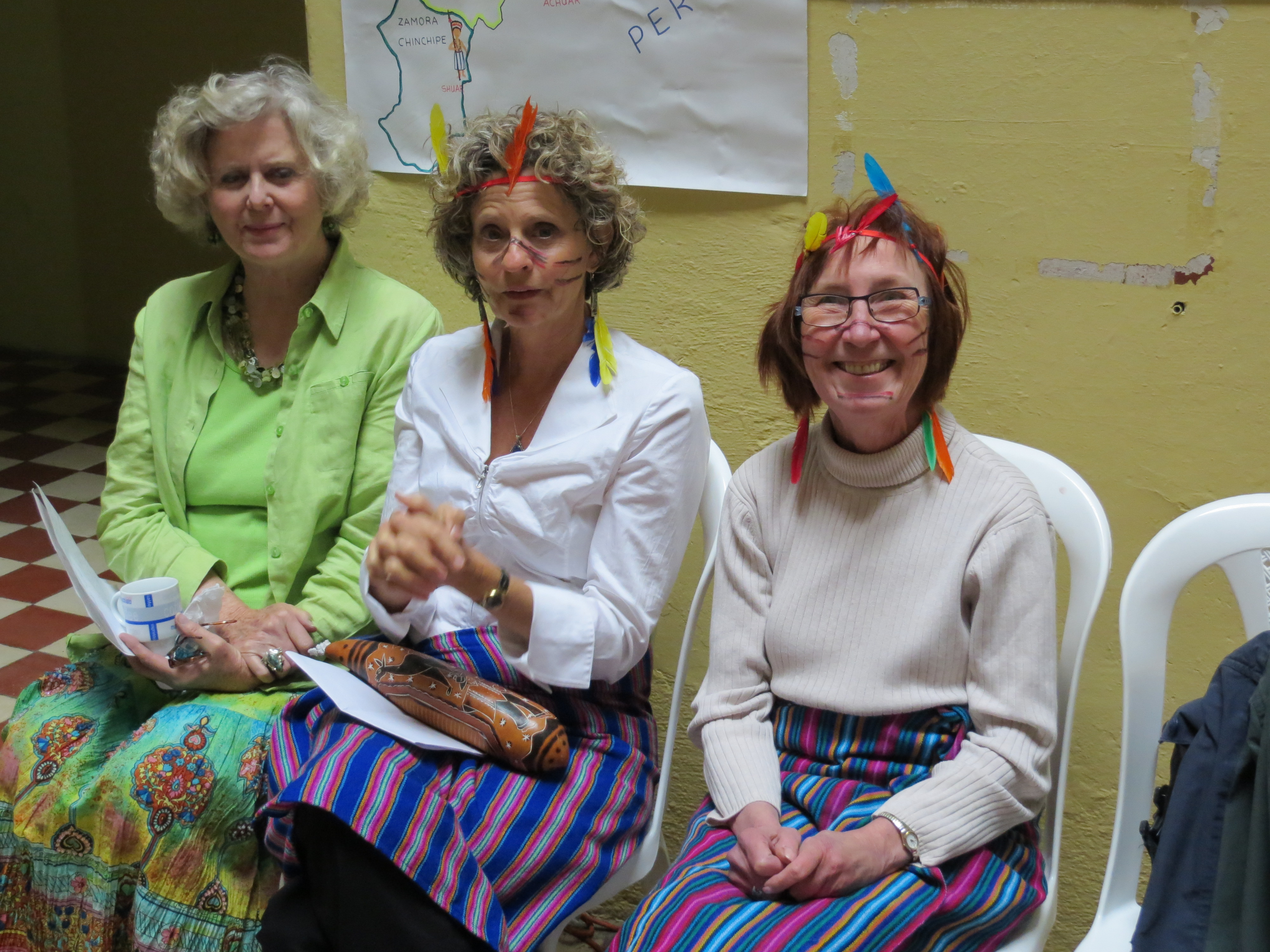
Jessie, Laura & Ann at la escuala Simon Bolivar

Afterward, Jessie & I visited the Museo Del Banco Central, aka Pumapungo, which has informative displays of the earliest habitation of the region (from about 1500 bc) through the Cañari and Inka and early colonial periods. It also has displays of typical ethic groups of the 4 regions of Ecuador.  The museum is situated on a large Cañari & Inka temple mound, and the grounds include old foundations and a terraced hillside, a well-maintained garden area with typical
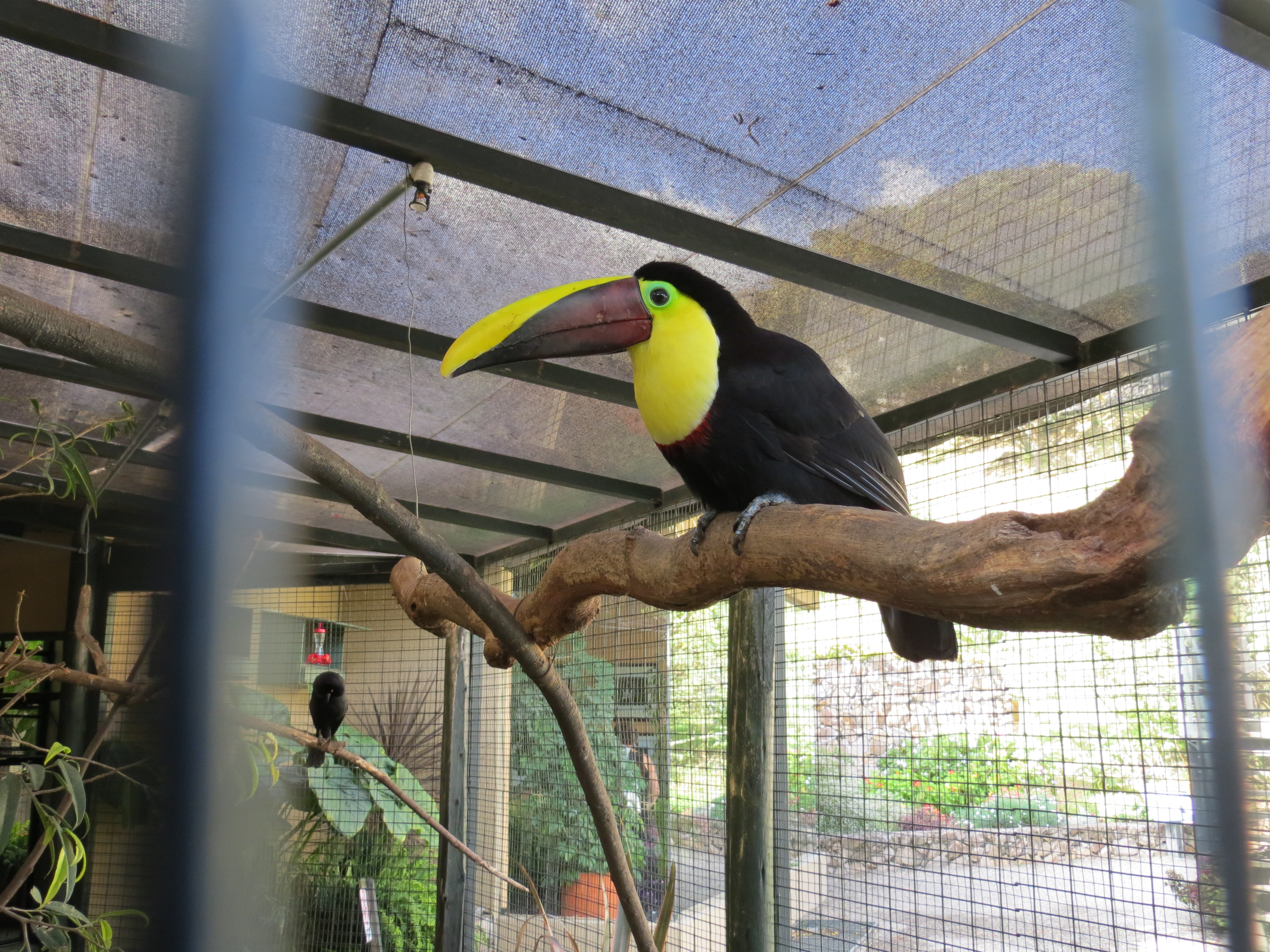
Toucan at Pumapungo

plants and agriculture, as well as an aviary (since the Inkas also had one on the site) featuring toucans, several types of parrots, large parakeets and buzzard-eagles.Saturday, under threatening skies, we went on a school-arranged bus trip to an early cave habitation site called Cueva de Chobshi dating from before 1500 bc, and a Cañari (pre-Inka) fortress.  The fortress was situated on a bluff high above a river in a beautiful countryside and had many stone artifacts scattered around the area.

On Sunday we went on an AHI-arranged tour to Ingaprica, a temple used first by the Cañari and then by the conquering Inkas, with examples of both styles of construction.  On the way we stopped by a roadside vender for some typical roasted pork skins and boiled corn.  Then we stopped at the Sactuario de la
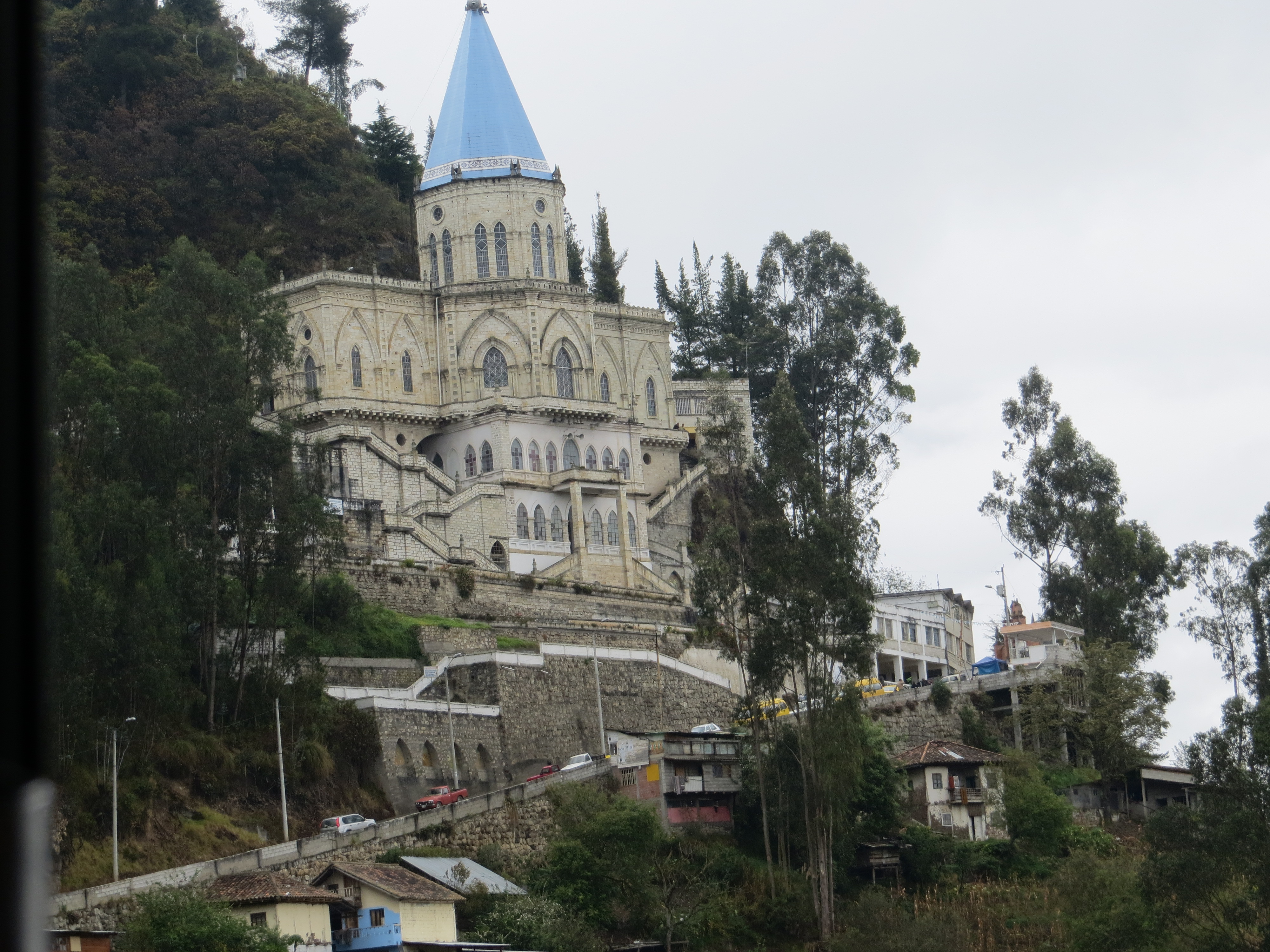
Sactuario de la Virgen del Rocio

Virgen del Rocio (Sactuary of the Virgin of the Dew) built on an Cañari and Inka temple site integrated onto a stone hillside high above the town of Biblian. 

We arrived at Ingaprica in a steady rain, and found it an intriguing site that was belatedly preserved starting about 40 years ago.  Before that some of its stones were used to help build the newer town near-by, so some of the current structures on the site are reconstructed.  Nevertheless, it shows the transition of the two types of usage and the distinctive Inka precision stone construction.
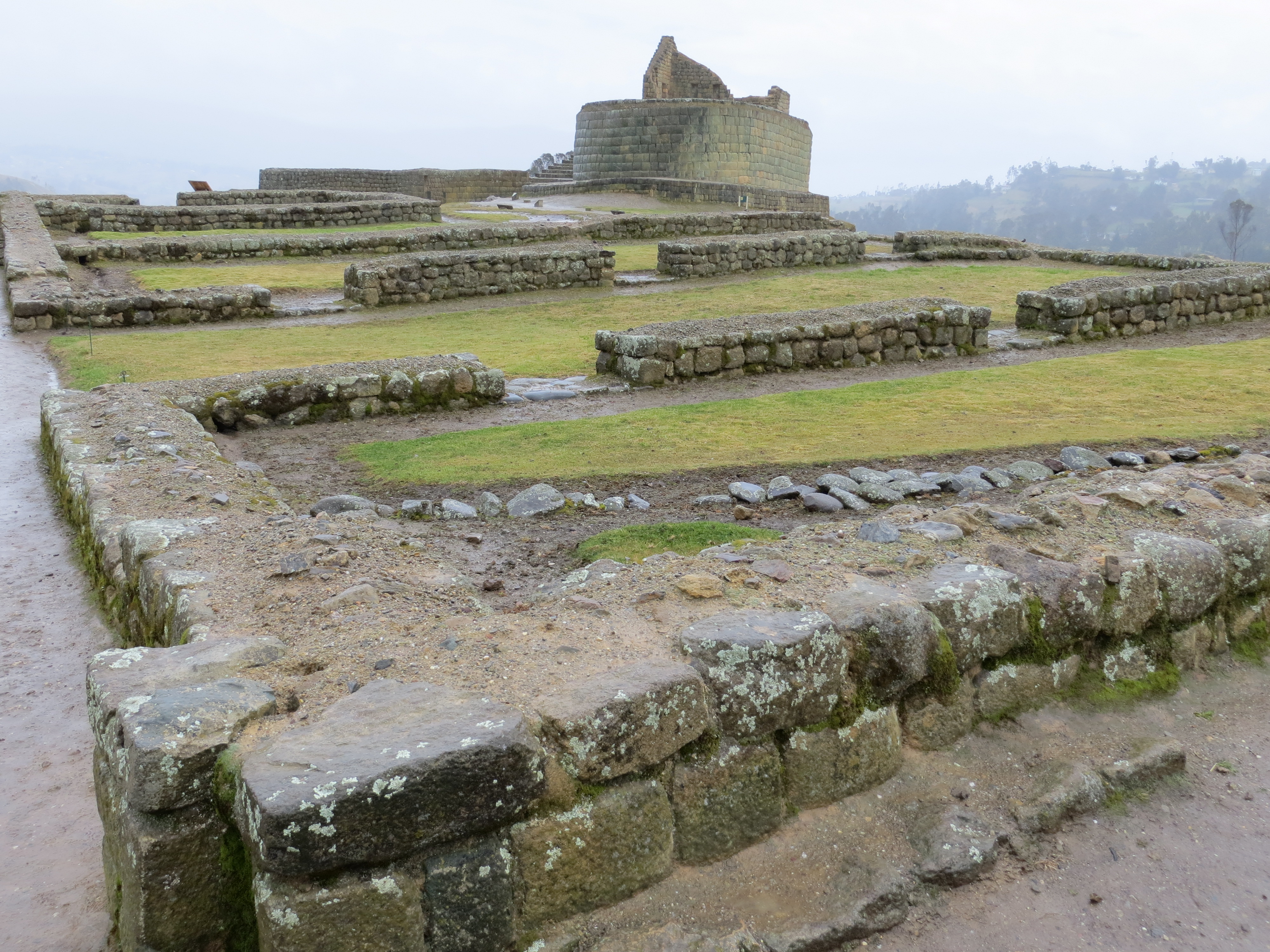
Inka temple at Ingaprirca

After a wet and cold day amble about the site, especially uncomfortable since we were at about 10,000 ft, thankfully the trip included a great 3-course lunch in a nearby old farm-house-turned hostel.

Settled in Cuenca

It’s Monday evening, the start of our second week of classes at the Simon Bolivar Spanish School in Cuenca, Ecuador.

We’ve settled into our apartment which is three blocks from the school and one block from the main square, Parque Abdón Calderón, in ‘old town’. Its very convenient to walk to the local mercardo’s or to take a taxi ($2) to the SuperMaxi which is just like an US super market.  Ecuador uses US currency, mixing in their own coins, which makes comparative pricing easy.

As I write this, I’m listening to the last night of a week-long religious celebration, consisting of music (singing & Andean flutes) and sermons broadcast on loud speakers from the nearby cathedral square, accompanied by fireworks.  Once this ends, usually around 10pm, the city is extremely quiet until the church bells start ringing around 6am, at sun-up.  Tonight the festivities & fireworks lasted until 11:20p.

Our personal “life style” guides and tutors are Santiago for Jessie and Esteban for John. Our 4 days of classes include, generally, 2 hours of individual tutoring at the school and 1.5 hours of excursions. We’ve gone to the cathedral,  museums, markets, or just visited the old town sights.

On martes (Tuesday), we went (individually) to a near-by market that included indigenous lady shamans offering personal cleansing. Jessie jumped at the chance to get straightened out. The process consists of light beating with a bundle of herbs (aromatherapy), followed by gusts of alcohol over the head & body (the shaman ingests some alcohol, then blows it out – sounds icky, but isn’t), then a massage with an egg to absorb bad spirits. Finally, the egg is broken into a plastic sack and “read”.  Jessie was pronounced “limpio” (clean), not nervous.

On miércoles (Wednesday), Jessie went to Feria Libre, a large market just out of town, 20-minute bus ride for 25¢.   Santiago showed her how to shop and bargain in the market.

On jueves (Thursday) the class visited the Homero Ortega Hat Factory which includes an interesting “Panama Hat” museum.  They are careful to document that the Panama, or toquilla,

John in Cajas Nat’l Park standing on Inca Trail

hat originated in Cuenca and the best are still handmade here.  The finished hats at the factory range in price from around $33 to $1000’s based on the quality of the reeds used and the handicraft in the making.  John bought himself a hat for $84.

Viernes (Friday) there were no classes, and we joined an AHI bus tour to the near-by Cajas National Park.  Starting at 8400′ altitude we climbed through the various climate zones to the 14,000′ pass and continental divide on the road to Guayaquil.  We got to explore a little of the area near the top, which was green with low ground cover and groves of ‘paper trees’ (named for their layers of bark) which, they say, are the only trees in the world that grow at that altitude.  On the way back down we stopped at a trout (trucha) farm and had a delicious meal.  Rainbow trout were introduced by the Spaniards, quickly dominating the native fish specifies and changing the ecosystem, including the extinction of a ‘swimming mouse’ that lost its main food source.

Sábado (Saturday) we joined a school-sponsored bus trip to an archeological site about 2 hours from Cuenca in El Tambo, called Coyoctor.  After arriving in El Tambo we boarded a trolley-like train which transported us about a mile to the 2 acre site nestled among active farms and residences.  The Coyoctor site was used by the Pre-Inca, the Kichwa people, and Incas as a ceremonial bath and royal residence, with the baths carved out of the andecite  rock, but also includes foundation rocks brought by the Incas from Cusco, Peru.  In the 1920’s a house was built on top of the site, and apparently the surrounding area is full of Inca artifacts on the farmed land.

On domingo (Sunday) we rested.  Jessie is contending with a nasty cough so we stayed close to our new home.  Cuenca pretty much shuts down on Sunday, with hardly anyone on the streets or in the few shops still open.  We found out that alcohol sales are not allowed on Sundays.

Intermixed with our schooling and trips, we’ve been eating very well.  For example, we had a wonderful meal at Tiestos on Saturday, which featured Ecuadorian ‘fusion’ plates of chicken & beef served family-style and a dessert served on plates with beautifully hand-painted confection designs.  This diner was hosted by AHI, but we’ve also had great 3-course lunches for as little as $2.25 each.  A typical tip is 8% or so.  We’ve not tried the Ecuadorian national dish, cuy,  yet but will soon.

Home in Cuenca

Jessie sampling exotic fruit in Gualaceo market

After traveling for 24-hours (with a 10 hour layover in Miami airport) we arrived in Quito for two nights at the upscale Swissotel where we were to meet up with our AHI group.  Jessie spent most of the following day trying to get the newer of her 2 PCs to work, and finally determined that it needed a new disk.  It contained all our camera support software & Skype, etc.  Dell is sending a replacement disk to Cuenca — we’ll see how that works out.

Quito is an elongated city in a valley between two mountains at about 9,500 feet.  On our 2nd day we took a city  bus ($.25 fare) around and did some walking, but not much else.  But it did get us acclimatized for our destination of Cuenca, which is a mere 8,400 feet altitude.

We arrived in Cuenca on Friday afternoon after joining the AHI group in Quito and flying over the cloud-covered Andes (with one volcanic, snow covered peak looming over the clouds).  We spent the first night in Hotel Victoria in the Old Town section of Cuenca.  It’s a very nice old hotel and our room overlooked the river and the newer Cuenca business district.  As in Quito, the weather was spring-like, 70’s during the day and 60’s at night.

On Saturday we were assigned our furnished apartment, a large studio on the 6th floor (with 2-person elevator) that has a glass partition to separate the sleeping area.  Our windows overlook the tile roof-tops of the neighborhood to the West, with just the steeples of several churches protruding in front of the surrounding green mountains.  The basic kitchen consists of modern cabinets and a long granite countertop.

The AHI group arranged a bus tour on Sunday (today) to near-by Gualaco that has a large fresh food market, and to Chordeleg which is known for its gold and silver jewelry.

The Gualaco market was an amazing collection of colorful stalls offering everything from fresh fruit and vegetables to eggs, potatoes, rice and corn.  The produce included quail and chicken eggs, bananas (of course), tree tomatoes, cherimoyo (deliciously sweet), chili peppers, huge radishes, and more, all in great abundance.  The vendors were indigenous Quichua women in white “Panama” hats, pigtails and colorful skirts.  We also visited the large meat market which featured cuy (Guinna pig) being roasted, chicken and roasted whole pig.  There we ate a typical plate of roast pork , lettuce & posole.

In Chordeleg we visited the jewelry exhibit which contains the “world’s largest earring” made of silver, about 4′ high and made the rounds of the dozens of  shops with their dazzling array of gold and silver jewelry.

The AHI group consists of 34 people, mostly older couples, from diverse parts of the US.  Tomorrow we start Spanish classes at 8:30am at the Simon  Bolivar school, and will be assigned individual “life-style guides” and language tutors for the next 4 weeks.  More soon…

Itinerary Cuenca

  • Tu Jul 3 – leave San Francisco
  • We Jul 4 – arrive Quito – stay Swisshôtel
  • Th Jul 5 – stay Quito – Swisshôtel
  • Fr Jul 6 – fly to Cuenca – stay Hotel Victoria
    • Bus tour of Cuenca
    • Welcome dinner, briefing, introduction to English-speaking doctor & dentist
  • Sa Jul 7 – transfer to apartment
  • Su Jul 8 – road trip
    • Viillage of Chordeleg – noted for ceramics, gold and silver filigree jewelry, Panama hats & pre-Inca ruins
    • Village of Gualaceo with lively Sunday morning market
    • Lunch -traditional pig roast
  • Mo Jul 9 – orientation at the Simon Bolivar Spanish School and first language lesson
  • Tu Jul 10 – continue Spanish lessons & lunch with locals
  • We Jul 11 – continue Spanish lessons & lunch with fellow travelers
  • Th Jul 12 – continue Spanish lessons, lunch with locals, and evening at La Parola, rooftop café
  • Fr Jul 13 – no school! maybe excursion to Cajas National Park and/or “Gringo Night” with fellow travelers and expats at Tiestos Café-Restaurant

Happy Independence Day from Miami International Airport

John was packed on Sunday. I was packed by 5 pm Tuesday when we left for the San Francisco Airport … and I was packed without a meltdown. Now it is 7 am in Miami and we are here until our flight for Quito leaves at 3. We will arrive
Quito this evening, spend tomorrow there, and be joined by the rest of the group tomorrow evening.  On Friday, we will fly to Cuenca to begin our “international living adventure.” So what is this adventure … we will stay in Cuenca, the third largest city in Ecuador, in a fully furnished apartment and have private Spanish lessons in a language school.

Jessie’s notes on Monday.

One day before we leave. John is all packed but I have spent my time setting up the blog! Time to get started with the packing.

We went to the Masters workout this morning and all wished us well on our travels.

Hello from John and Jessie!

This is our first post as we prepare for our trip to Ecuador.